Changelog Aug 07, 2026 - Neon
A new Console layout for the Neon backend, more AI Gateway models, API keys and multiple accounts in the Neon CLI, and more
A new Console layout for the Neon backend
Section titled “A new Console layout for the Neon backend”The Console sidebar has a new shape. Every branch-level Neon backend service now sits at the same level.
- Postgres database is everything that was in the sidebar before: Tables, SQL Editor, Backup & Restore, Computes, Data API, Roles, and Databases, now under one collapsible item.
- Auth, Object storage, Functions, and AI Gateway backend services sit alongside it as siblings.
Above that section, the sidebar separates what belongs to project (Dashboard, Branches, Integrations, Settings) from what belongs to the branch (Overview, Credentials, Monitoring, Child branches). The branch picker sits between them, so it's clear which branch you're looking at when you open a service.
Overview is now a summary of the branch you have selected. It lists each backend service with its status, so you can see what the branch actually has enabled without opening each one:
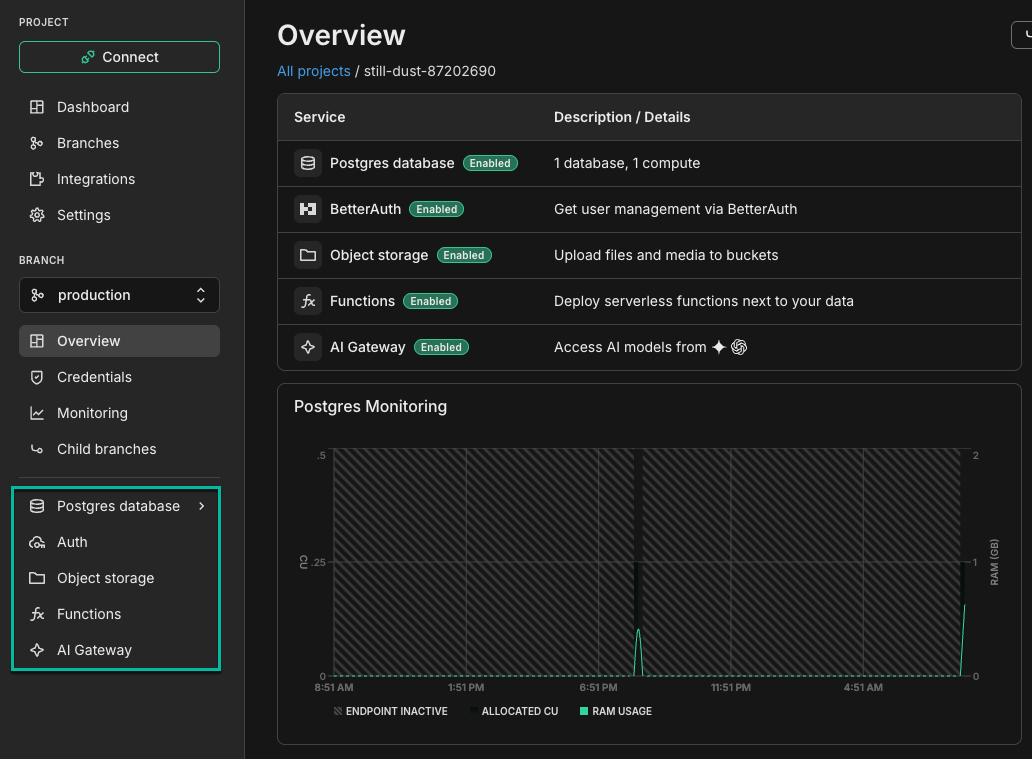
Each service shows whether it's enabled on the branch, so the page doubles as a list of what you can still add.
More models on the AI Gateway
Section titled “More models on the AI Gateway”We've expanded the models available through the Neon AI Gateway, including Kimi K3, GLM-5.2, Inkling, and new additions to the Gemini and GPT families.
The catalog now spans frontier and open-weight models from OpenAI, Anthropic, Google, Meta, Moonshot AI, Alibaba, Zhipu AI, and Thinking Machines. One credential and one base URL reach all of them, so trying a different model means changing a string rather than signing up with another provider:
curl -X POST "$NEON_AI_GATEWAY_BASE_URL/v1/chat/completions" \
  -H "Authorization: Bearer $NEON_AI_GATEWAY_TOKEN" \
  -H "Content-Type: application/json" \
  -d '{"model": "kimi-k3", "messages": [{"role": "user", "content": "What is Neon?"}]}'
Browse the full catalog in the model reference, where you can filter by provider or open weights and open any model for a copy-paste quickstart. To see what your own project can reach right now, call GET /v1/models.
Project-level permissions for all orgs
Section titled “Project-level permissions for all orgs”Last week we introduced project-level permissions to newly created organizations. Existing organizations are now supported, so every team on Neon has the four organization roles (Admin, Editor, Viewer, and Collaborator) and per-project permissions.
See Neon now has per-project permissions for the announcement, and User permissions for the complete documentation.
API keys and multiple accounts in the Neon CLI
Section titled “API keys and multiple accounts in the Neon CLI”There are two new additions to the Neon CLI that go together: api-keys mints credentials, and profile stores them and switches between them. Together they let you give an agent a credential that reaches exactly one project, or work across a personal account and a work organization without juggling config directories.
Manage API keys withneon api-keys
Section titled “Manage API keys withneon api-keys”Minting a key used to mean opening the Console or hand-rolling a neon api request. neon api-keys now covers listing, creating, and revoking keys at every scope:
neon api-keys create --name ci                                        # account key
neon api-keys create --name ci --org-id org-example-12345678          # organization key
neon api-keys create --name agent --project-id green-breeze-12345678  # one project only
Project-scoped keys are the reason this matters. A key created with --project-id can't create projects, can't mint more keys, and can't see any other project, which makes it safe to hand to an agent or a CI job instead of sharing your account.
See the neon api-keys reference and Manage API keys for key types and permissions.
Use more than one account withneon profile
Section titled “Use more than one account withneon profile”The CLI could only hold one account at a time, so anyone working across two built their own workaround out of --config-dir and shell aliases. A profile is a name pointing at a credentials file, selected per invocation with --profile or NEON_PROFILE:
neon auth --profile work                                            # create or re-authenticate
neon deploy --profile work                                          # use it
neon profile create ci --mint --project-id green-breeze-12345678    # or hold a scoped key, no browser
A profile can hold a browser sign-in or an API key, which is where it meets the scoped keys above. --mint signs in once, keeps only the minted key, and signs the session back out, so afterwards nothing about the profile can open a browser.
The CLI also now stores its configuration in $XDG_CONFIG_HOME/neon, or ~/.config/neon if that isn't set. A pre-existing neonctl directory is still read in place, so there's no migration step.
See the neon profile reference for the full command set and for how --profile resolves against NEON_API_KEY.
New NAT gateway IPs and VPC endpoint services in Europe (Frankfurt)
Section titled “New NAT gateway IPs and VPC endpoint services in Europe (Frankfurt)”We've expanded infrastructure capacity in the AWS Europe (Frankfurt) region (eu-central-1) with new NAT gateway IP addresses and new VPC endpoint service addresses for Private Networking.
If you use Private Networking in eu-central-1, you can now use the additional VPC endpoint service addresses for enhanced capacity and reliability. See the Regions documentation for the complete list of NAT gateway IPs and the Private Networking guide for VPC endpoint service addresses by region.