Connect from TypeORM to Neon
TypeORM is an open source ORM that lets you to manage and interact with your database. This guide covers the following topics Connect to a database on Neon from TypeORM Use connection pooling with Typ...
Pre-built prompt for connecting Node.js applications to Lakebase Postgres using TypeORM.
TypeORM is an open-source ORM that lets you to manage and interact with your database. This guide covers the following topics:
Connect to a database on Neon from TypeORM
Section titled “Connect to a database on Neon from TypeORM”To establish a basic connection from TypeORM to a database on Neon, perform the following steps:
-
Retrieve your database connection string. You can find the connection string for your database by clicking the Connect button in the Console nav. Select a branch, a user, and the database you want to connect to. A connection string is constructed for you.
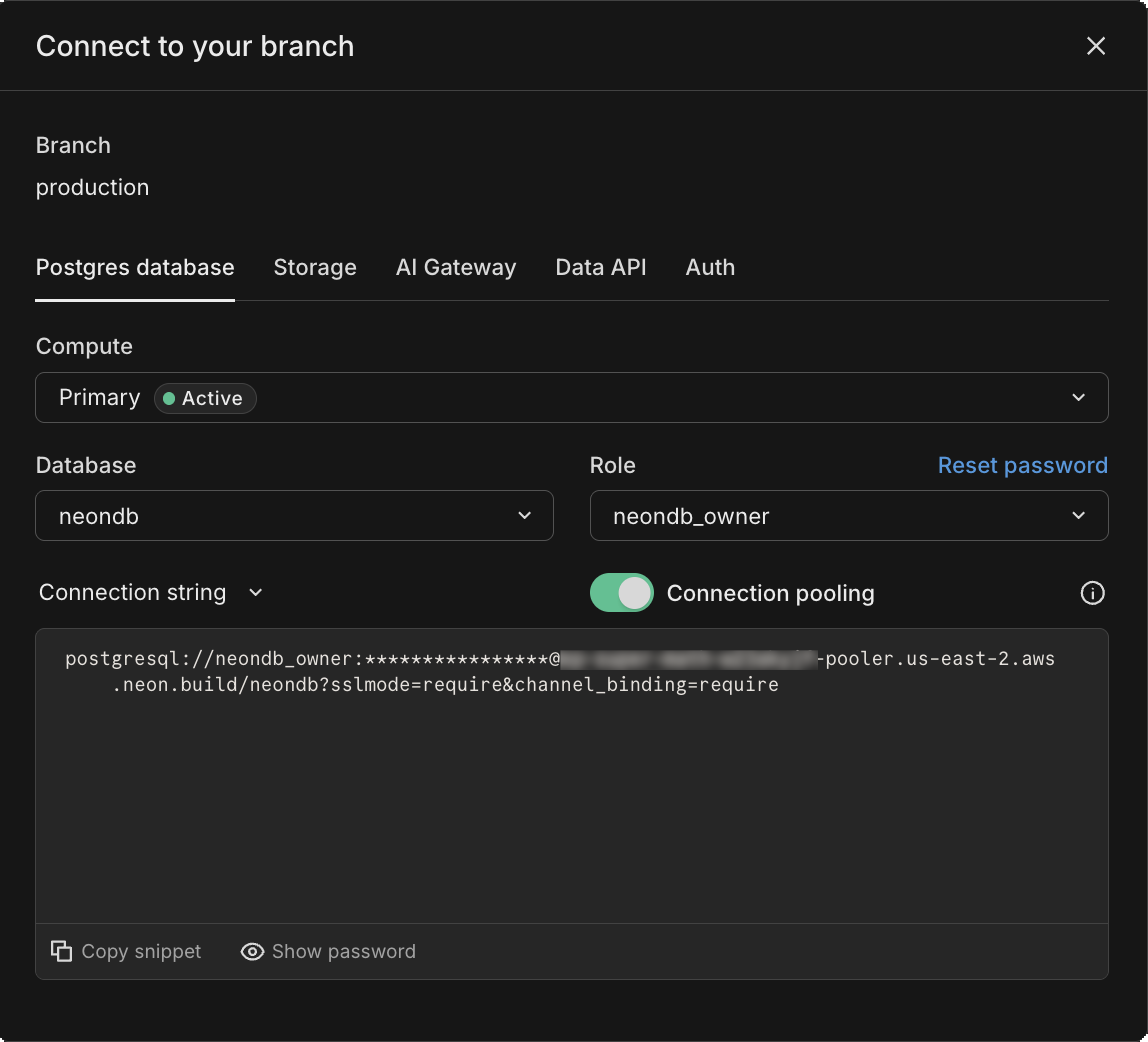 The connection string includes the user name, password, hostname, and database name.
 -
Update the TypeORM's DataSource initialization in your application to the following:
TypeScript import { DataSource } from 'typeorm'; export const AppDataSource = new DataSource({ type: 'postgres', url: process.env.DATABASE_URL, ssl: true, entities: [ /*list of entities*/ ], }); -
Add a
DATABASE_URLvariable to your.envfile and set it to the Neon connection string that you copied in the previous step. We also recommend adding?sslmode=require&channel_binding=requireto the end of the connection string to ensure a secure connection.Your setting will appear similar to the following:
DATABASE_URL="postgresql://[user]:[password]@[neon_hostname]/[dbname]?sslmode=require&channel_binding=require"
Use connection pooling with TypeORM
Section titled “Use connection pooling with TypeORM”Serverless functions can require a large number of database connections as demand increases. If you use serverless functions in your application, we recommend that you use a pooled Neon connection string, as shown:
# Pooled Neon connection string
DATABASE_URL="postgresql://alex:AbC123dEf@ep-cool-darkness-123456-pooler.us-east-2.aws.neon.tech/dbname?sslmode=require&channel_binding=require"
A pooled Neon connection string adds -pooler to the endpoint ID, which tells Neon to use a pooled connection. You can add -pooler to your connection string manually or copy a pooled connection string from the Connect to your branch modal, which you can access by clicking Connect in the Console nav. Enable the Connection pooling toggle to add the -pooler suffix.
Connection timeouts
Section titled “Connection timeouts”A connection timeout that occurs when connecting from TypeORM to Neon causes an error similar to the following:
Error: P1001: Can't reach database server at `ep-white-thunder-826300.us-east-2.aws.neon.tech`:`5432`
Please make sure your database server is running at `ep-white-thunder-826300.us-east-2.aws.neon.tech`:`5432`.
This error most likely means that the TypeORM query timed out before the Neon compute was activated.
A Neon compute has two main states: Active and Idle. Active means that the compute is currently running. If there is no query activity for 5 minutes, Neon places a compute into an idle state by default.
When you connect to an idle compute from TypeORM, Neon automatically activates it. Activation typically happens within a few seconds but added latency can result in a connection timeout. To address this issue, you can adjust your Neon connection string by adding a connect_timeout parameter. This parameter defines the maximum number of seconds to wait for a new connection to be opened. The default value is 5 seconds. A higher setting may provide the time required to avoid connection timeouts. For example:
DATABASE_URL="postgresql://[user]:[password]@[neon_hostname]/[dbname]?sslmode=require&channel_binding=require&connect_timeout=10"Next steps
Section titled “Next steps”- Set up Managed Better Auth: Add managed authentication that branches with your database
- Add Object Storage: S3-compatible file storage that branches with your database
- Deploy a Function: Run backend compute next to your database, no separate hosting needed
- Call an LLM with AI Gateway: Access foundation models from Anthropic, OpenAI, Google, and more with one credential
Need help?
Section titled “Need help?”Join our Discord Server to ask questions or see what others are doing with Neon. For paid plan support options, see Support.